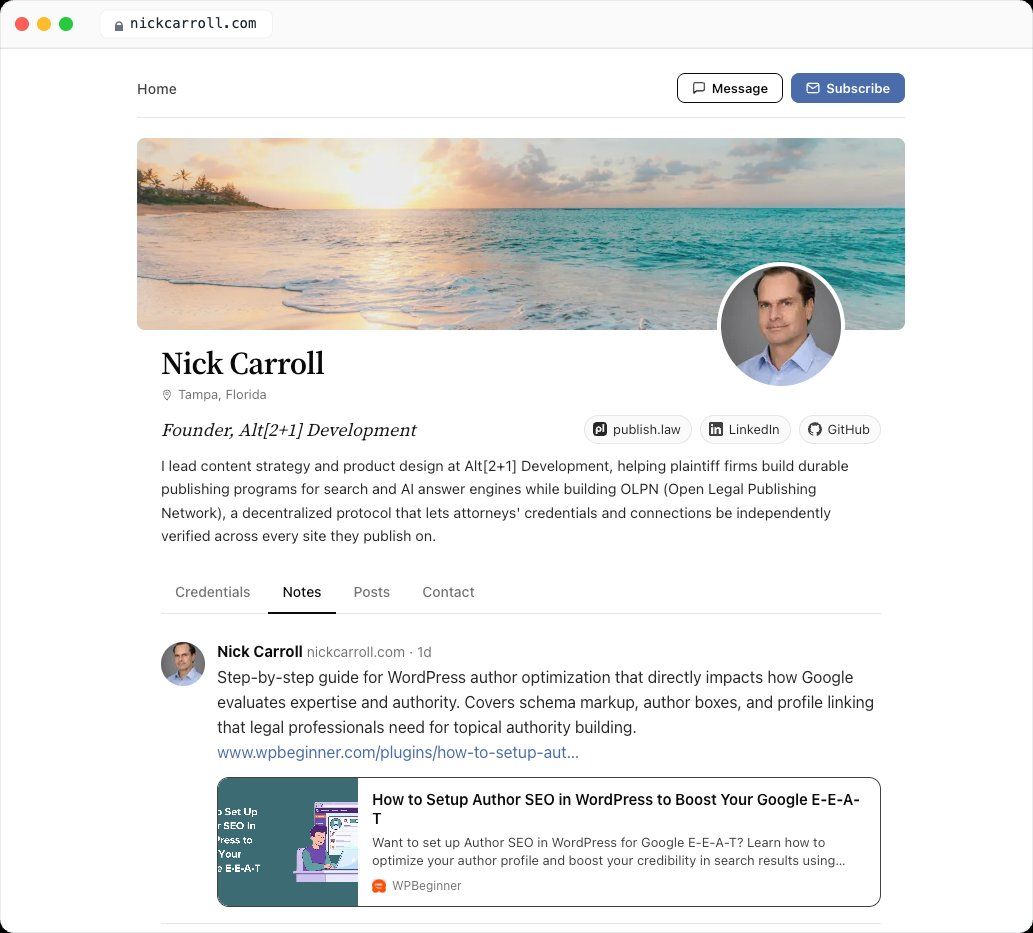
Publish.law is a personal site for legal professionals. Profile, credentials, writing, and identity, on a URL that's yours, that travels with you when your career does.
Why we built it
Modern search surfaces people, not pages. When someone asks AI to find a lawyer who handles a particular kind of case, or to summarize the work of an attorney they've heard of, AI looks across the web for signals: who's written about this area, who's been cited by name, whose credentials check out. For legal questions specifically, a category Google holds to a higher bar, the answers come from sources AI can verify.
The problem is that most attorneys' professional identity is scattered across places they don't control. LinkedIn owns the connection graph. Avvo owns the rating. The firm bio belongs to the firm. None of these are designed to showcase a body of writing under your name, and most of them don't survive a job change.
Publish.law is the home that ties it together under a name and URL that's yours.
Who it's for
Publish.law is built for legal professionals whose careers, ideas, or audiences outgrow their firm websites.
Your firm bio reads what your firm wants it to read. The topics you can cover on the firm blog stop where the firm's risk tolerance, marketing plan, or practice-area boundaries stop. The credit for cases that come in through the firm intake form goes to the firm. And when you move firms, all of it resets to zero on day one of the next job.
A site at your own URL is different. The writing is yours. The credentials are yours. The leads and cases that come in through your site are credited to you. The bio reads what you want it to read. And when you write about an area of law the firm doesn't formally practice, or take a position the firm hasn't endorsed, or experiment with a format the firm blog doesn't, that's between you and your readers.
For associates and young attorneys, that means building a presence that's deliberately your own from day one, independent of which firm name happens to sit on the door this year. For partners, it means a place where your point of view and your business development efforts get the attribution and the freedom they don't get on the firm site.
A publish.law site doesn't compete with the firm site. It reinforces it. Another surface where clients and search engines can find you, another path to the firm.
But, it's not for firms. And, it's not for truly solo attorneys whose firm site already represents them well.
It's for attorneys who'd rather own the platform than be a paragraph on someone else's.
What you get
Free, forever, on yourname.publish.law:
A profile with credentials, experience, properties, and social links
Notes: short-form posts under your name, with link previews
Share notes to LinkedIn
SEO, RSS, and structured data on everything you publish
Paid plans add:
Ad-free site (Pro)
Custom domain: point yourname.com at your site (Pro)
Contact page with inquiries inbox and ABA-aligned disclaimer (Pro)
Appearance options to match how you want it to look (Pro)
Long-form posts and pages with categories and navigation (Pro+)
Newsletter with subscriber management and double opt-in (Pro+)
Pricing
Free: $0 forever. No credit card.
Pro: $29/month
Pro+: $89/month
Switch plans or cancel anytime from your dashboard.
Founding supporter: Lifetime Publisher
We're capping a hundred Lifetime Publisher slots at $1,595, paid once. Pro+ for life, no renewals, no price increases. The early support funds the work of building publish.law into the product it should be: better analytics, federation, more credential types, more useful integrations. Once the hundred slots fill, the offer closes for good.
See it in practice
Take a look at Jessica Pride, who represents survivors of sexual assault and trafficking in San Diego. Or Jed Cain, a Louisiana trial lawyer handling catastrophic injury, maritime, and product liability cases.
What's coming
This blog is where we'll cover features as they ship, milestones as they hit, and where to find us in person.
What's on the way:
Better analytics, so you can see what's working
Replies to notes, turning publish.law into a network you can actually converse on
Comments on posts, so the conversation happens on your site, not someone else's